Brand & Design Systems Lead
/
2025
Skynet
Skynet is a modular, no-code platform that enables anyone to create intelligent, commerce-ready agents for the Virtuals Protocol ecosyste
$191k
raised in private sale
250+
blockchain interactions
8000+
MCP Tools
The Business & Background
The agent economy has an adoption problem, and it isn't ideas.
Hundreds of thousands of autonomous agents have launched. A tiny fraction are actually commerce-active. The gap between those two numbers isn't a lack of good ideas — it's what stands between an idea and a working agent: 6+ months of development, $20,000+ in cost, and a technical gauntlet most projects don't survive.
Why development fails before it starts:
A useful agent isn't one integration, it's fifty — spread across 250+ blockchain networks, 3,000+ DeFi protocols, dozens of AI/ML providers, plus social platforms, payment systems, and monitoring tools. Every one of those is its own integration problem. String enough of them together and you get the same pattern every time: a brilliant idea, months of coding, an integration nightmare, and a project that quietly dies before it ships.
The barrier was never imagination. It was the six months of plumbing standing between an idea and a live agent.
Product Gallery
[ Screens are drag-able ]


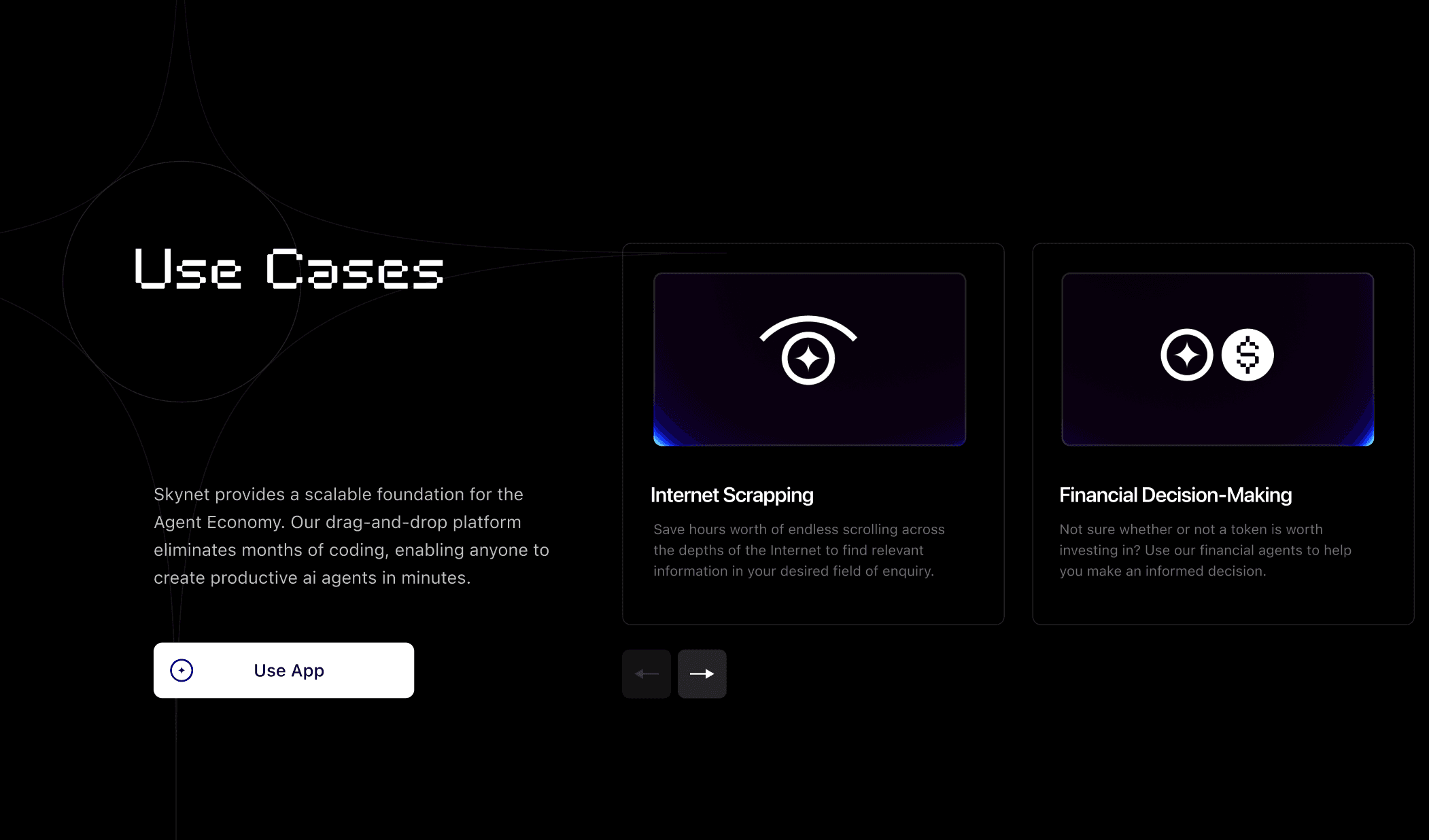


// OUTCOMES & IMPACT
The Solution
Skynet turns a 6-month build into an 18-minute one.
It's a drag-and-drop agent builder for Web3 and the Virtuals Protocol ecosystem — built on a simple premise: we pre-built Integration Hell so nobody else has to live in it.
Visual, not technical. A drag-and-drop workflow builder with real-time preview — professional-grade agent creation without writing code.
8,000+ tools, one click away. Standardized MCP (Model Context Protocol) connectivity means any service is a connection, not a custom integration job.
Web3-native from the ground up. 250+ blockchain integrations and 3,000+ DeFi protocols available natively, with multi-chain deployment, gas optimization, and MEV protection built in — not bolted on.
Commerce-ready on day one. Native Virtuals Protocol integration means agents can transact autonomously and generate revenue immediately, with transparent fees from the first transaction.
The Shift
Traditional Agent Development | Skynet |
|---|---|
6+ months to build | 18 minutes |
$20,000+ minimum cost | No dev cost |
50+ manual integrations | 8,000+ pre-built, one-click |
Coding required | Visual, no-code |
Most projects abandoned mid-build | Ship the same day |
[ PROCESS ]
Challenges
No-code, drag-and-drop agent builders went from a niche idea to a crowded category fast. Once the concept proved out, well-funded players moved in with marketing budgets Skynet couldn't match, and distribution, not product, became the harder problem to solve.
We built a faster, more capable way to create commerce-ready agents. What we didn't have was the acquisition spend to put that in front of the market at the same scale as bigger brands entering the same space.
What that meant in practice- competing on product depth and speed-to-value rather than reach, winning users who found Skynet through the product itself, not through a marketing budget we didn't have.
I led product design and brand identity for Skynet, from the visual workflow builder's UX down to the brand guidelines that carried it into pitch decks and marketing.
On the product side, that meant designing the drag-and-drop builder itself: making a system with 8,000+ tools and hundreds of integrations feel like an 18-minute build rather than a technical maze. On the brand side, I built the identity and guidelines from scratch; visual language, tone, and the assets that made Skynet legible to both Web3-native users and non-technical founders.
I also contributed directly to GTM through positioning, narrative and the materials used to take Skynet to investors. That effort helped raise $191,000+ in a private round.
// extras
Additional Work
Full-scale product design, from prototype to the final deal. Some GTM and motion stuff too.
Reflection
You can build revolutionary products and define the UX for them before the market even has a demand for these products. But if you aren't able to solidify your marketing, distribution and overall GTM efforts, you will be fighting a losing battle.