Lead Product Designer
/
2024 — PRESENT
Spheron Network
Designing the interface layer for the world’s largest decentralized compute network.
44,000+
gpus providers on-boarded
$12M
in annual revenue
$100M
worth of compute secured
The Business & Background
The training and deployment of large AI models remains highly centralized. A handful of corporations not only control the most capable models but also dominate the compute infrastructure required to build and operate them. While this concentration brings efficiencies of scale, it also introduces systemic vulnerabilities. Decisions about infrastructure and access are made privately, user dependence deepens, and opportunities for broader participation are constrained. As experiments in distributed training prove increasingly viable, the possibility of running models across open, community-driven networks is shifting from theory to practice.
We at Spheron Network, directly addressed these challenges by creating a decentralized marketplace for compute. Rather than relying on a few cloud incumbents, we aggregate under-utilized GPUs and CPUs from data centers, independent operators and individual contributors into a global infrastructure layer. Through our network, developers can rent scalable compute for AI training, inference, and other intensive workloads, while resource providers earn from otherwise idle capacity. This approach lowers barriers to entry and redistribute control over access to compute for model training to build a more open and resilient AI ecosystem.
[messari, Austin Freimuth]
Product Gallery
[ Screens are drag-able ]



// OUTCOMES & IMPACT
The Solution
Spheron Network addressed this through a DePIN platform for transacting compute resources with low overhead and low technical barriers to entry. Developers, startups and enterprises can spin up their own compute marketplaces, complete with custom governance and UI, without building the underlying infrastructure from zero.
The network runs on three components: specialized nodes running Kubernetes to orchestrate deployments, a matchmaking engine for peer-to-peer compute transactions and an on-chain payment system that compensates providers and distributes incentives for instant settlement.
Its architecture splits into two node types. Provider Nodes manage enterprise-grade data center resources; Fizz Nodes extend participation to decentralized GPU contribution at the edge, for tasks like AI inference. The matchmaking engine connects the two sides, selecting providers on price, uptime and location, while smart contracts formalize leases and settle payments transparently.
Provider Nodes and the Matchmaking Engine
Enterprises supply GPU and CPU capacity by registering devices through the network's smart contracts, making their hardware available for lease and eligible to respond to deployment requests.
Here's the flow: a user's deployment request hits the Matchmaking Engine's Order Smart Contract, which emits an order event. Providers monitoring the network bid on it, specifying resources and pricing. Once the bidding window closes, the engine scores every bid against seven factors, balancing performance, cost, and fairness-
Geographic region and availability zone — minimizes latency, meets data residency requirements
Price competitiveness — ensures a fair market rate
Uptime and availability history — rewards reliable providers
Reputation — weighted by prior network performance
Resource availability — confirms capacity to fulfill the request
Stake and slashing history — incentivizes good behavior
Randomness — prevents deterministic selection from favoring a small set of providers.
__________________________________________________________________________________________________________
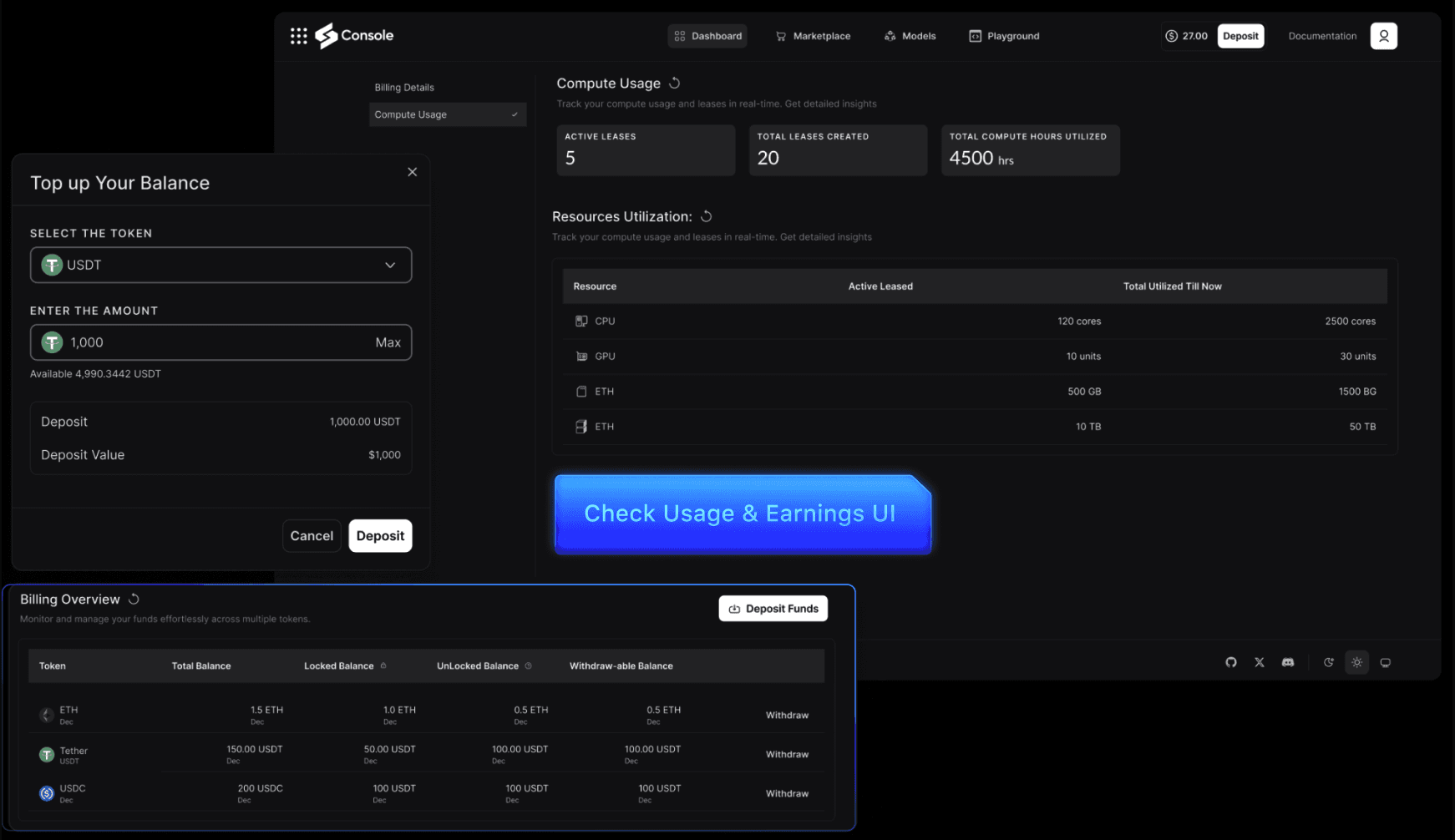
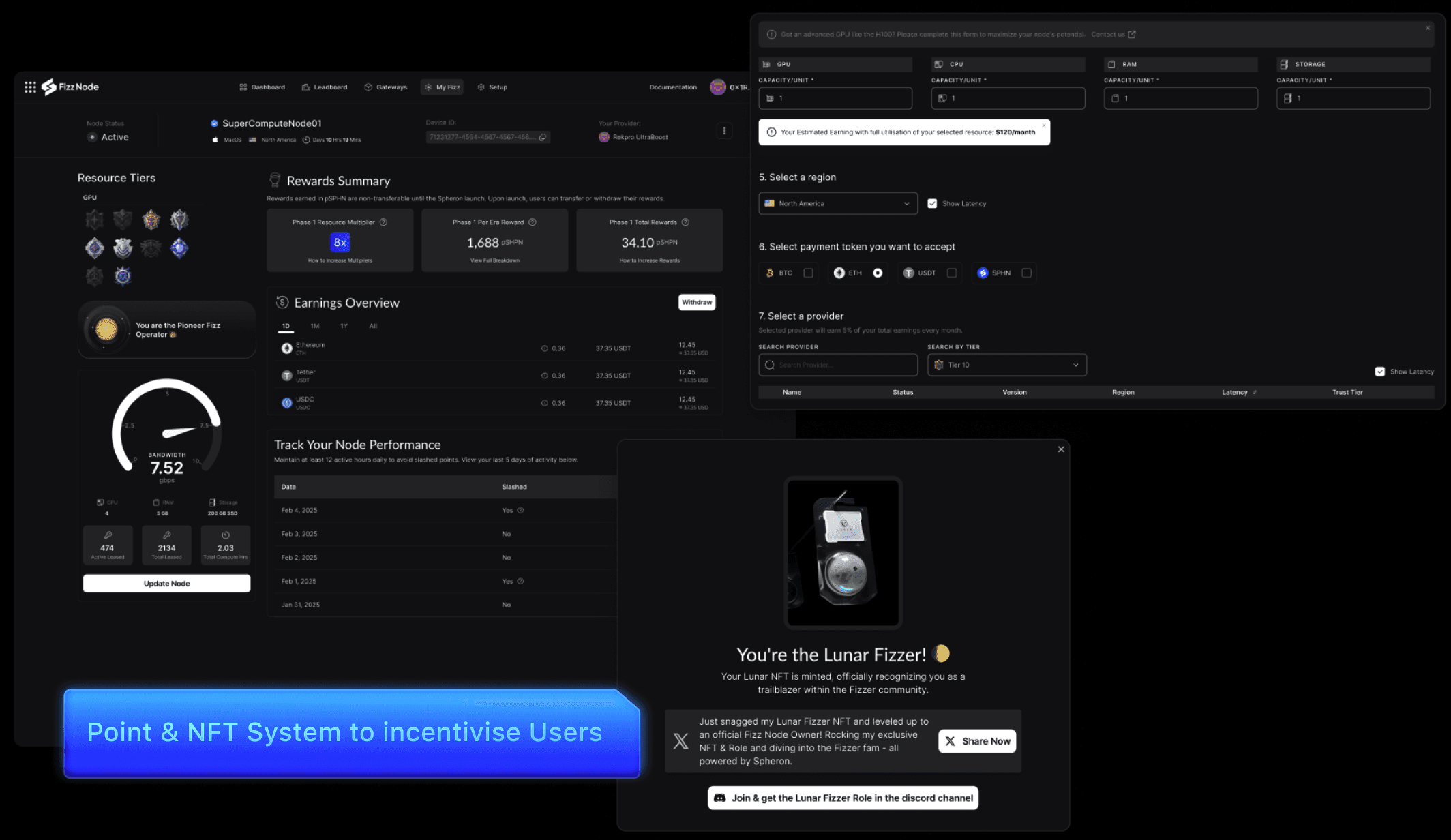
I led product design initiatives across Spheron's GPU Network through long chats with the founders and end-to-end research from users in order to ship screens with sublime UX.
It was a moment of pride for us to end up creating an 8 figure business opportunity by our 5th month in operations ($12 million ARR as of Aug-Sept 2025). My work on the design system was extensive as it covered the bare-bone structure of the product end-to-end. This was the pre AI era so every UI component, be it trays, icons, nav bars, charts, etc were all hand built with intent.
[ PROCESS ]
Challenges
Decentralized compute has no central switchboard. It has to coordinate thousands of contributors; laptops, gaming rigs, idle data center capacity across every geography, capacity tiers and reliability levels to match the supply <> demand fairly and transparently.
There's no intermediary to enforce the deal either, only smart contracts. They have to ensure that providers get paid and users get the resources they were promised, while staying simple enough that someone offering a spare GPU can join without infrastructure expertise.
The hard part wasn't any single screen. It was that the network has three groups of users with genuinely different needs, and one bad assumption in either direction breaks the incentive model.
// extras
Additional Work
Apart from deep product design tasks, I was also involved in a complete rebrand for Spheron Network. I designed a series of new brand guidelines that helped Spheron to push steam ahead of its TGE Launch and larger GTM efforts. Spheron secured a whopping $17 million in their token's supply. Along with this, I also created some animations and motion pieces too for our brand new landing page.
Reflection
The lesson that stuck: clarity is a feature you have to defend every sprint. The hardest work was removing things, not adding them.